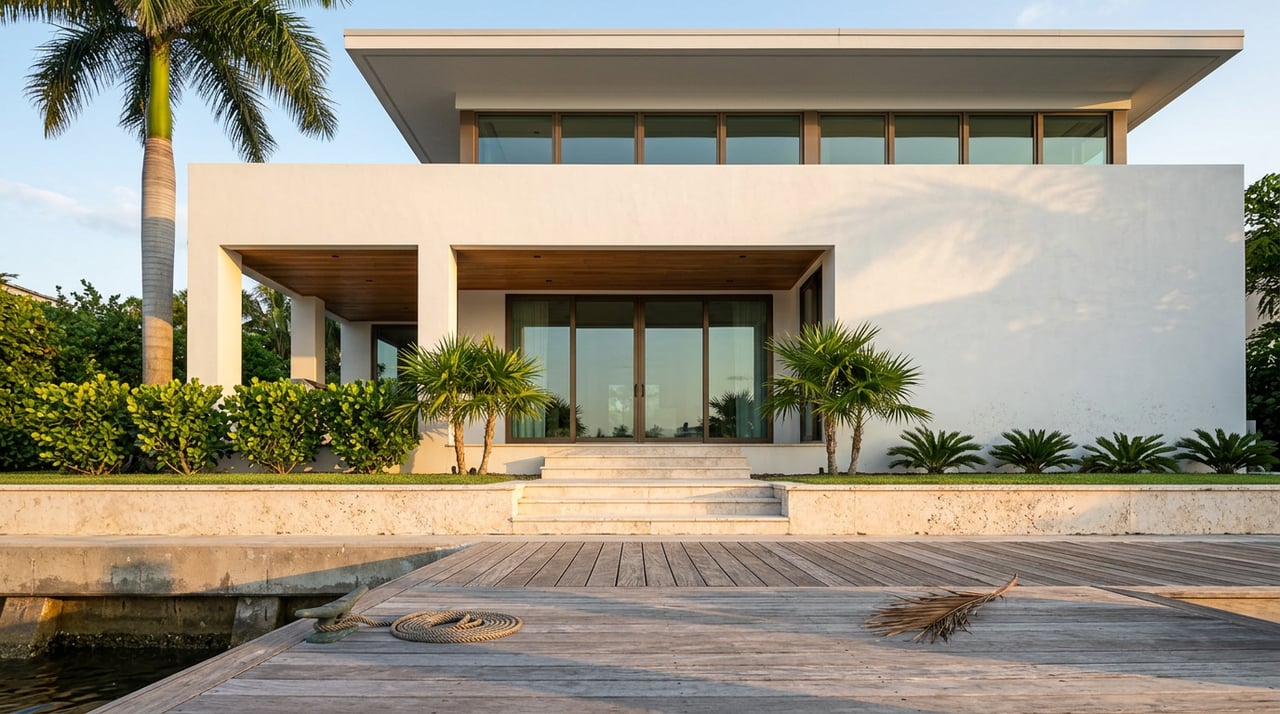
A waterfront estate at 270 South Hibiscus Drive closed this month for $51.5 million, the highest price and the highest price per square foot ever paid on Palm or Hibiscus Island. Read as a headline, it looks like confirmation that the market is only getting hotter. Read against the number of homes that actually change hands here each year, it tells a different story. On these two islands, a single sale does not confirm a trend. It sets one.
That distinction matters more to a buyer weighing Palm and Hibiscus against Miami Beach's other gated waterfront enclaves than any median price you will find on a portal.
The Sale That Reset the Benchmark
The 9,100-square-foot mansion at 270 South Hibiscus Drive sits on two bayfront lots totaling 21,000 square feet with 120 feet of frontage on Biscayne Bay. The price worked out to $5,800 per square foot of livable space, according to The Real Deal. The five-bedroom home includes a nightclub, a fitness center, and two private docks capable of accommodating a yacht up to 105 feet. A joint venture led by Luis Bosch, founder of Luis Bosch Luxury Homes, was the seller. Dora Puig represented the buyer, whose identity has not been disclosed.
The sale surpassed a previous record of roughly $40 million set by Chilean developer Claudio Fischer on neighboring Palm Island, a spec mansion sale that itself came on a larger lot with a larger home. Price per square foot, not size, is what moved this time.
Zoom out one degree and the pattern gets more interesting. Kevin Segalla, founder of the gaming publisher Tilting Point, sold his home at 320 South Hibiscus Drive for $31.9 million last year to a buyer linked to a Delaware entity. Robert Rivani, founder of the development firm RIVANI, paid $23 million for a Palm Island waterfront estate with plans for a full renovation. On the smaller end, Brad Pitt's manager, Cynthia Pett-Dante, paid $5.1 million for a non-waterfront home at 185 South Hibiscus Drive, itself a record price per square foot for a non-waterfront property on the island. Miami Heat guard Victor Oladipo listed his own Hibiscus Island home for close to $10 million during his team's playoff run.
Five names, five very different price points, one island pair. That range is the first clue that this is not a market you can summarize with a single average.
Why One Closing Can Move the Median 226 Percent
Here is the number that should give any comparison shopper pause. Redfin recorded Palm Island's median sale price at $22.9 million in January 2026, up 226 percent from the same month a year earlier. That is not a market appreciating. That is a market where the sample size is so small that one closing determines the headline.
Current inventory tells the same story. As of early August 2026, Hibiscus Island had approximately 11 homes and lots listed at a median price of $18.5 million, or roughly $4,040 per square foot. Palm Island had about 9 active listings with a median price of $23.2 million, or roughly $3,570 per square foot. Over the trailing 180 days, only about 3 homes closed on Hibiscus and about 4 on Palm.
| Island | Active listings (early Aug 2026) | Median list price | Median $/sq ft |
|---|---|---|---|
| Hibiscus Island | ~11 | $18.5M | ~$4,040 |
| Palm Island | ~9 | $23.2M | ~$3,570 |
When a neighborhood trades single digits every six months, the median is a snapshot of whoever happened to sell, not a trend line you can extrapolate. A buyer comparing Palm and Hibiscus to a larger market like Sunset Islands or the broader Venetian Islands needs to treat every reported average here as a data point from a small, thin pool rather than a statistically stable baseline.
What the Money Actually Buys
Palm and Hibiscus connect to each other by a short bridge off the MacArthur Causeway, gated and guarded at a single entry point, which is why buyers and brokers tend to discuss them as a pair even though the two operate as distinct micro-markets. Palm Island tends toward larger lots and grander, older-money architecture. Hibiscus skews slightly denser with more recently built or renovated tropical modern estates, which is part of why its price per square foot has been setting records this year while overall lot sizes stay smaller than Palm's.
Both islands were created by Army Corps of Engineers dredging completed in 1922, the same project that built neighboring Star Island. That shared origin explains why all three read as a single architectural era to a casual observer even as their price tiers and buyer profiles diverge. Star Island draws more of the ultra-trophy attention. Palm and Hibiscus draw buyers who want comparable privacy and dock access without competing for the handful of listings that ever surface on Star.
The Paperwork That Does Not Show Up in the Listing Photos
Every one of these homes was built for boating, and boating infrastructure on a barrier island comes with a compliance history that a listing photo will never show you. Miami Beach's Seawall Ordinance, amended in July 2025, requires any new seawall to be built to an elevation of 5.7 feet NAVD, or 4 feet NAVD if designed to support a future increase to that height. A seawall in disrepair that lets tidal water flow onto adjacent property can draw a $250 fine for the first offense and $500 per day after that, with the owner given 730 days to complete repairs once cited, according to the city's own seawall program. On islands built a century ago, this is not a hypothetical. It is a question every buyer's inspection should answer before an offer goes in.
The permitting process already got faster, and it has been that way for a while now. Miami-Dade County's Board of County Commissioners approved a seawall permitting reform in July 2025, introducing what the county calls the Gold Key system, fully in effect since that December. Before this ordinance, seawall permits in Miami-Dade commonly took 18 to 24 months to clear review, well behind Broward and Palm Beach counties, where similar approvals typically closed in 3 to 6 months. Under the new rules, the county must issue a Completeness Summary within 10 days of an application, can request additional information no more than three times, and must reach a final decision within 90 days of that Completeness Summary. Permit modifications now get a 30-day review window. Details are laid out by Breezy Permits, a firm that tracks the ordinance closely.
For a buyer eyeing an older estate that will need seawall work, that shift from a two-year process to a defined 90-day decision changes the math on whether to close now and renovate, or wait for a seller to complete the work first. By now, any application on Palm or Hibiscus Island should already be moving through the faster track.
There is already a real example of what a compliant, modern seawall looks like on these exact islands. A 3D-printed Living Seawall was installed on Palm Avenue, Palm Island's own main road, replacing an aging structure with panels designed to meet current standards while also inviting fish and other marine life to colonize the wall, according to Kind Designs, the firm behind the project. It is a useful reference point for what "brought up to code" actually looks like on the water here, rather than an abstract permitting requirement.
What to Ask Before You Write an Offer
- Request the seawall's elevation certification and confirm whether it meets the 5.7 foot NAVD standard or the 4 foot interim allowance
- Ask for permit history on the dock, seawall, and any lift equipment, and confirm the paperwork matches what is physically installed
- If work is needed, ask whether the application would fall under the new Gold Key timeline and what that means for your closing date or renovation schedule
- Compare the property's actual dock length, depth, and bridge clearance against your vessel rather than relying on general "waterfront" language in the listing
- Treat any reported median or year-over-year percentage for Palm or Hibiscus Island as a reflection of a handful of sales, not a market-wide trend
Frequently Asked Questions
Are Palm and Hibiscus Island the same real estate market? They share a gate, a bridge, and a 1920s dredging origin, but they behave as two distinct micro-markets. Palm tends toward larger lots and higher overall price points. Hibiscus has recently posted higher price per square foot on newer construction despite smaller average lot sizes.
Does the new seawall permitting reform apply retroactively to existing seawalls? The Gold Key timeline applies to new permit applications submitted after the ordinance took effect. Existing seawalls remain subject to the elevation and maintenance requirements already in place, and any application to repair or replace one now moves through the faster review window.
Why did Hibiscus Island's price per square foot jump so sharply this year? Limited inventory combined with a run of newly built or fully renovated waterfront estates, including the record sale at 270 South Hibiscus Drive, pushed the ceiling higher. With only a handful of annual closings, a few high-end trades can move the reported average substantially.
If you are weighing Palm or Hibiscus Island against another gated waterfront enclave in South Florida, the headline number is rarely the whole picture. Carlo Dipasquale works these micro-markets directly, from dock permitting to comparing what a given price actually buys island by island. Schedule a private consultation to talk through what fits your plans before you make an offer.